Some annotated jottings about Mark Thompson's MacTaggart lecture.
"Top-slicing is firmly off the agenda".
I'm afraid there's still time for this, if Jeremy Hunt finds something he'd rather spend the money on.
"[Audiences] want the best and they want it all year round, which is why nowadays we play pieces like Sherlock, The Normans and Rev in high summer."
I'm afraid that's an example of capitalising on unexpected success.
[Our opponents' tactics] "Exaggerated claims about waste and inefficiency. Nit-picking about the detailed mechanisms of governance and accountability. Even some – not all, but some of the calls for greater transparency".
I'm afraid it's not just the newspapers. The Coalition can't afford to halt the drive for transparency in the public sector. It's key to winning what will be diminishing public support for spending cuts.
[The future of the organisation] "Simpler structures, fewer layers, fewer management boards".This could be really radical. At the moment there are four boards that matter - Vision, Audio & Music, Journalism, and Future Media & Technology. It will be a very clever DG/management consultant who cracks this one. But it's vital to drive down the number of apparatchiks, and to reduce those salaries that have unnecessarily strayed above £200k.
Saturday, August 28, 2010


Friday, August 27, 2010
New Shield
After two years spinning (mainly for Douglas Alexander) at the Department for International Development, former BBC political correspondent James Hardy is back at the BBC, looking after the reputation of "Journalism", and Gold Commander Mark Byford.
James, once described by the Guardian as a Harry Enfield look-a-like, had a distinguished career as a hack - as both royal and political editor for the Press Association, home affairs editor at the Sunday Telegraph and political editor of the Daily Mirror.
Previous reputation manager for news, John Shield, left in May, to join bus and rail operator Go Ahead as Director of Corporate Affairs.
James, once described by the Guardian as a Harry Enfield look-a-like, had a distinguished career as a hack - as both royal and political editor for the Press Association, home affairs editor at the Sunday Telegraph and political editor of the Daily Mirror.
Previous reputation manager for news, John Shield, left in May, to join bus and rail operator Go Ahead as Director of Corporate Affairs.
Thursday, August 26, 2010
Everyone's going - eventually
Martin Wainwright, who writes a weekly commentary on matters "Northern" for Guardian.co.uk, has extracted the following email reply from the BBC about "living and working in the north".
So we need to set up a checklist for 2013. Still no mention of Barbara Slater's intentions.
"All our executives will be living and working in the north from day one, when our new base in Salford Quays opens next year. All BBC staff who are relocating and who own a home have the option to rent initially if they have specific circumstances that require them to keep their family home in the south-east (eg if their children will be mid-way through their A-levels), for up to two years before relocating their family home to the north. A number of more junior staff have also chosen this option and the rules are exactly the same for all.
"Peter Salmon, director of BBC North, will be living and working in Salford from day one, and he will relocate his family once his children have finished their exams, which is the commonsense thing to do. Although he would be entitled to relocation costs at that time, he has voluntarily decided to relocate at his own expense, not licence fee payers'.
"In addition, Adrian Van Klaveren, Controller of 5 Live and Richard Deverell, chief operating officer, will also be renting initially for family reasons. Others such as Joe Godwin, director of BBC Children's and Saul Nasse, controller of BBC Learning, will be moving their families from the beginning.
"Whilst executives are committed to relocating their families in the longer term, our relocation policy is designed to allow some flexibility in recognition of the impact that relocations like this can have on family life".So we need to set up a checklist for 2013. Still no mention of Barbara Slater's intentions.
Wednesday, August 25, 2010
WOCC around the clock
Tim Davie has welcomed the BBC Trust's decision to create more space for indies to compete with in-house radio production teams. He would do; but that wasn't his recommendation to the Trust.
BBC Audio & Music currently has a commitment to taking 10% of its output from independent production companies. In fact, over the last three years it has exceeded that figure, by 2 or 3 per cent. On top of that, Radio 4 operates a "Window of Creative Competition" for a further ten per cent of its airtime, where BBC teams and indies compete.
The BBC Executive proposal was to increase the indie quota to 12.5% all round - essentially a reflection of the current reality. It did not want a WOCC for Radios 1,1Xtra, 2, 3, 5, 5Live Sports Extra, 6Music, 7 and the Asian Network. The Trust said keep the quota at 10%, but YOU WILL IMPLEMENT A 10% WOCC across all radio.
The Trust's review also picks at the BBC for poor management information, a late commitment to cost benchmarking, and notes that indies have lower costs per hour in general - though that may be because they are mostly offered the cheaper commissions.
Grant Goddard's independent report on the BBC/Indie relationship is instructive. The BBC side always complains that they get too many offers to handle in open commissioning, and thus try to work with lists of preferred suppliers. The Catch 22 is that you can't get on the lists without previous experience of network commissions. The indie side point out that the BBC seems to be able to ride every commission with a dedicated accountant, going line by line through deals as small as £8,000 - taking time and any potential profit out of their side of the contract.
BBC Audio & Music currently has a commitment to taking 10% of its output from independent production companies. In fact, over the last three years it has exceeded that figure, by 2 or 3 per cent. On top of that, Radio 4 operates a "Window of Creative Competition" for a further ten per cent of its airtime, where BBC teams and indies compete.
The BBC Executive proposal was to increase the indie quota to 12.5% all round - essentially a reflection of the current reality. It did not want a WOCC for Radios 1,1Xtra, 2, 3, 5, 5Live Sports Extra, 6Music, 7 and the Asian Network. The Trust said keep the quota at 10%, but YOU WILL IMPLEMENT A 10% WOCC across all radio.
The Trust's review also picks at the BBC for poor management information, a late commitment to cost benchmarking, and notes that indies have lower costs per hour in general - though that may be because they are mostly offered the cheaper commissions.
Grant Goddard's independent report on the BBC/Indie relationship is instructive. The BBC side always complains that they get too many offers to handle in open commissioning, and thus try to work with lists of preferred suppliers. The Catch 22 is that you can't get on the lists without previous experience of network commissions. The indie side point out that the BBC seems to be able to ride every commission with a dedicated accountant, going line by line through deals as small as £8,000 - taking time and any potential profit out of their side of the contract.
Jobs for the...
There must be a degree of twitchiness amongst the 400 or so staff at the doomed North West Development Agency - most based in Warrington. Will the Coalition's proposed replacement - local enterprise partnerships - come up with jobs they can apply for ?
Originally the NWDA canvassed support for the idea of simply changing into the NWLEP. But the good burghers of the region have seen a better opportunity, and Eric Pickles will be peppered with applications to set up smaller groups. The ubiquitous Sir Howard Bernstein was first out of the traps with a Greater Manchester LEP proposal. Cheshire & Warrington is another applicant. Lancashire can't agree, and is proposing three LEPs - Pennine Lancashire, The Fylde Coast, and Lancashire County Council. Liverpool will apply as a city. The deadline is a week or so away.
Does it matter ? If these groups control the funds that once went to the NWDA, then it does. What happens to Phase 2 of MediaCityUK, for example ? How does that play in Lancashire, Cheshire and Liverpool ?
If, of course, the funds dry up, then LEPs are just talking shops - and unlikely to provide employment opportunities for the 400 Broomhead Boys and Girls.
Originally the NWDA canvassed support for the idea of simply changing into the NWLEP. But the good burghers of the region have seen a better opportunity, and Eric Pickles will be peppered with applications to set up smaller groups. The ubiquitous Sir Howard Bernstein was first out of the traps with a Greater Manchester LEP proposal. Cheshire & Warrington is another applicant. Lancashire can't agree, and is proposing three LEPs - Pennine Lancashire, The Fylde Coast, and Lancashire County Council. Liverpool will apply as a city. The deadline is a week or so away.
Does it matter ? If these groups control the funds that once went to the NWDA, then it does. What happens to Phase 2 of MediaCityUK, for example ? How does that play in Lancashire, Cheshire and Liverpool ?
If, of course, the funds dry up, then LEPs are just talking shops - and unlikely to provide employment opportunities for the 400 Broomhead Boys and Girls.
Tuesday, August 24, 2010
Black hole
BBC computer boffins have been called in to exercise deep magic on servers at the Corporation's Millbank offices. This is unusual for August, when the drives should be idling during the Parliamentary holidays. The suspicion is that policy wonks working on the DG's Edinburgh speech may have something they want to retrieve. If the oration is short on stats, it may be the boffins have failed...
Monday, August 23, 2010
And another thing
Paul Gaskin, the BBC HR Director for the North who has decided to leave the post after two months and not move to Salford, was on a salary of £190k pa; his total package was worth £197,900. A short scan of online ads today for HR directors in the north (by me) has produced none offering more than £80k. There is one ad offering a "six-figure package" - to look after ITN staff - in London.
Reed produce an annual review of salaries in HR, and this is their chart produced in February this year for HR Directors, working across all sectors.
Min Max Avg
Scotland £50,250 £105,350 £71,200
N Ireland £51,250 £97,750 £71,200
Wales £52,500 £98,750 £75,000
North £56,300 £108,200 £82,250
Midlands £57,800 £105,200 £81,500
London £70,500 £160,900 £115,700
South East £57,200 £120,800 £89,000
South West £55,200 £110,000 £82,600
Reed produce an annual review of salaries in HR, and this is their chart produced in February this year for HR Directors, working across all sectors.
Min Max Avg
Scotland £50,250 £105,350 £71,200
N Ireland £51,250 £97,750 £71,200
Wales £52,500 £98,750 £75,000
North £56,300 £108,200 £82,250
Midlands £57,800 £105,200 £81,500
London £70,500 £160,900 £115,700
South East £57,200 £120,800 £89,000
South West £55,200 £110,000 £82,600
Away from base
You do wonder about BBC job interviews for Salford. Do they ask applicants to commit to living within, say, 40 miles of their new base - or not ?
Paul Gaskin is the latest to apparently change his mind about moving. One presumes he was interviewed for the role of HR Director for the North around May this year -at time when "moving or not" was a big issue for all Salford-bound posts.
Paul came from Serco (he still hasn't changed his Linkedin profile), but had different views about job obligations and mobility when he first joined that organisation. He came to run HR for the Transport and Dubai division, when the company had won the contract to build the Dubai Metro. This from Serco Pulse, an internal website about inspirational leaders.
In addition to his UK duties, Paul was charged with strengthening the executive team in Dubai so it could manage this massive workload, and with forming new teams responsible for delivery. Within days of joining the division, he was on a plane to Dubai to see the challenges ahead of him. He concluded that the only way to succeed was to base himself there and manage his UK responsibilities remotely – effectively doing two jobs at once.
Paul Gaskin is the latest to apparently change his mind about moving. One presumes he was interviewed for the role of HR Director for the North around May this year -at time when "moving or not" was a big issue for all Salford-bound posts.
Paul came from Serco (he still hasn't changed his Linkedin profile), but had different views about job obligations and mobility when he first joined that organisation. He came to run HR for the Transport and Dubai division, when the company had won the contract to build the Dubai Metro. This from Serco Pulse, an internal website about inspirational leaders.
In addition to his UK duties, Paul was charged with strengthening the executive team in Dubai so it could manage this massive workload, and with forming new teams responsible for delivery. Within days of joining the division, he was on a plane to Dubai to see the challenges ahead of him. He concluded that the only way to succeed was to base himself there and manage his UK responsibilities remotely – effectively doing two jobs at once.
The pace of change
During my journalistic career at the BBC, I was also associated with a range of failed building projects. A Norman Foster scheme for a radio centre on the site of the Langham Hotel, and an RHWL scheme, in two phases, for a news centre and radio centre at White City were the "highlights". The most recent and probably the most unlikely has succeeded; the completed redevelopment of Broadcasting House will be handed over to the BBC soon.
During the design work on these schemes, I tried to educate myself about the best of the British architecture and construction. The most influential buildings at the time of the first White City development (in the late 80s) were Arup's initial contributions to the Broadgate scheme. We tried not to be influenced by the later SOM blocks, but were fascinated by their construction techniques.
Now the talk is of demolition of part of Broadgate, for a new scheme by Make for UBS. I commend Amanda Baillieu's thoughts on the issue, which also take a swipe at Wirral Waters.
During the design work on these schemes, I tried to educate myself about the best of the British architecture and construction. The most influential buildings at the time of the first White City development (in the late 80s) were Arup's initial contributions to the Broadgate scheme. We tried not to be influenced by the later SOM blocks, but were fascinated by their construction techniques.
Now the talk is of demolition of part of Broadgate, for a new scheme by Make for UBS. I commend Amanda Baillieu's thoughts on the issue, which also take a swipe at Wirral Waters.
Sunday, August 22, 2010
Naming conventions
There's a stop on the Metrolink tram network in Manchester currently called GMEX, after the nearby exhibition centre and venue. But the name is going to change when the network signage is refreshed, to coincide with the new spur running to MediaCityUK at Salford Quays.
There's some irony in all this - originally, G-MEX was a railway station, Manchester Central, offering express services to London St Pancras - and the station's huge canopy mirrored that of the London terminus. Manchester Central closed for business in 1969, and GMEX (Greater Manchester Exhibition Centre) opened in 1986. In 2001, a conference centre was added to the complex, called MICC (Manchester International Conference Centre). In 2007 the whole site was rebranded Manchester Central - the obvious name, which should have stuck.
But, no ! The new name for the Metrolink station will be Deansgate-Castlefield - which councillors claim will end confusion, help thousands of visitors and BBC staff.
A wag commenting on the story at the Place North West website asks: "Is it a kindly helpful hand to the neighbouring authority [Salford] or a cunning plan to show them where the real shops and bars are ?"
There's some irony in all this - originally, G-MEX was a railway station, Manchester Central, offering express services to London St Pancras - and the station's huge canopy mirrored that of the London terminus. Manchester Central closed for business in 1969, and GMEX (Greater Manchester Exhibition Centre) opened in 1986. In 2001, a conference centre was added to the complex, called MICC (Manchester International Conference Centre). In 2007 the whole site was rebranded Manchester Central - the obvious name, which should have stuck.
But, no ! The new name for the Metrolink station will be Deansgate-Castlefield - which councillors claim will end confusion, help thousands of visitors and BBC staff.
A wag commenting on the story at the Place North West website asks: "Is it a kindly helpful hand to the neighbouring authority [Salford] or a cunning plan to show them where the real shops and bars are ?"
Friday, August 20, 2010
Feast east
It must say something about the banqueting facilities in and around MediaCityUK; delegates to this year's Radio Festival at The Lowry, Salford Quays will have to find their way six miles east round the A57(M) to Gorton, on the other side of Manchester, for the festival dinner.
The venue is The Monastery. One presumes drink will be served, as the following day's programme only lasts till 1300.
The venue is The Monastery. One presumes drink will be served, as the following day's programme only lasts till 1300.
Hooray
Brilliant news from the BBC - they're finally creating an archive database by scanning back copies of the Radio Times. In the days of my direct employment there, I used to bang on about this something rotten, spurred by the creation of excellent Times pdf archive.
I hope, in the end, this becomes a public database. The next stage, however, is important. There are still people obsessed with metadata at the Beeb - i.e. summarising programme information, rather than storing everything. Please, just store it - and let cleverer people work on new ways of searching the store.
I hope, in the end, this becomes a public database. The next stage, however, is important. There are still people obsessed with metadata at the Beeb - i.e. summarising programme information, rather than storing everything. Please, just store it - and let cleverer people work on new ways of searching the store.
Thursday, August 19, 2010
Mission impossible
The Salford Star reports a possible brouhaha over plans for the Oasis Academy MediaCityUK - plans which require the demolition of the empty, yet locally-listed, Salford Central Mission.
Despite the Gove cuts, this academy, driven by media-friendly, sponsorship-heavy minister Steve Chalke, seems to be secure in its funding. What WILL the planners do ?
Despite the Gove cuts, this academy, driven by media-friendly, sponsorship-heavy minister Steve Chalke, seems to be secure in its funding. What WILL the planners do ?
Bigger picture
The excellent NPR, moving way ahead in the field of transparency on audience figures, has combined listening via radio, and use of its website, in these slides. It mirrors the work done by the FT to combine print and online readership stats. Come on, BBC....
Finger from the Dyke
One can imagine some spluttering over the muesli at Thompson Towers this morning. The BBC's DG is just over a week away from two important events: The MacTaggart Lecture at the Edinburgh International TV Festival - and revealing details of a second "go" at sorting the BBC Pension Fund deficit. Things are probably already pretty tense.
So, muttering from the sidelines, comes Greg Dyke, in comments to The Independent.
...the former BBC director-general Greg Dyke says that the corporation's bosses, through their generous pay packages, are giving encouragement to the Government to take a knife to the BBC. "I do think that at a senior level they haven't really acted as they should have done in terms of senior salaries. I think the salaries at the BBC are a red rag to a bull at a time when the Government is cutting organisations because too many public-sector people are earning too much money," he says. "I think the chairman of the [BBC] Trust [Sir Michael Lyons] should have done something about it, and hasn't."
The analysis of many is that the Gregster, whilst making the Corporation feel happy, set the framework in which salaries soared away, and failed to balance the books, in a sort of "deficit denier" way about licence fee income. The question for Thommo, and his various finance and personnel chiefs, is have they done enough to turn it round in the six subsequent years ?
So, muttering from the sidelines, comes Greg Dyke, in comments to The Independent.
...the former BBC director-general Greg Dyke says that the corporation's bosses, through their generous pay packages, are giving encouragement to the Government to take a knife to the BBC. "I do think that at a senior level they haven't really acted as they should have done in terms of senior salaries. I think the salaries at the BBC are a red rag to a bull at a time when the Government is cutting organisations because too many public-sector people are earning too much money," he says. "I think the chairman of the [BBC] Trust [Sir Michael Lyons] should have done something about it, and hasn't."
The analysis of many is that the Gregster, whilst making the Corporation feel happy, set the framework in which salaries soared away, and failed to balance the books, in a sort of "deficit denier" way about licence fee income. The question for Thommo, and his various finance and personnel chiefs, is have they done enough to turn it round in the six subsequent years ?
Wednesday, August 18, 2010
Snifter
Things seem to be livening up at St Peter's College, Oxford - just in time for the arrival of Mark Damazer from BBC Radio 4. The English dons have set up an alumni weekend, which, amid seminars, lectures and the rest, features a 6.30pm whisky tasting session (Chavasse Quad)(the venue, not a brand) ahead of dinner. Is this the right way round ?
The saga of Smooth
Smooth Radio goes national in October, with Simon Bates, at the age of 62, getting his first go as "pop" breakfast dj. He'll be followed in the schedule by Mark Goodier, 49, Dave Lincoln 57 (estimated), Carlos, 43, and Andy Peebles, 61. Until 2007, most of the frequencies used by Smooth were owned by Saga Radio.
Tuesday, August 17, 2010
Necessity is the...
Back to the 70s seems to be the mantra for BBC television drama under Jay Hunt and boy wonder Ben Stephenson. Andrew Davies is doing a new three-part version of South Riding, the novel by Winifred Holtby - last produced in 1974 by Yorkshire Television, starring Dorothy Tutin. A three-part version of Upstairs Downstairs is in production in Wales, starring Keeley Hawes. Jay and Ben have commissioned "Young James", a three-part prequel to "All Creatures Great and Small", about James Herriot (real, less dramatic name - Alf Wight) learning his trade as a vet in Glasgow. NB: The real confidence of commissioners - three parts each time !
Of course, it's not all good news for 70s fans - this year J & B canned the remake of Survivors. And there's still no sign of a return for Play for Today.
Of course, it's not all good news for 70s fans - this year J & B canned the remake of Survivors. And there's still no sign of a return for Play for Today.
Skewered
The power of the blogosphere. It's now nearly two months since Gill Edmonds wrote up details of a bizarre online delivery solution from Sainsbury's (you have to read it yourself). But it continues to win coverage, and is apparently now rattling around dinner tables in France.
Monday, August 16, 2010
Put your shirt on it
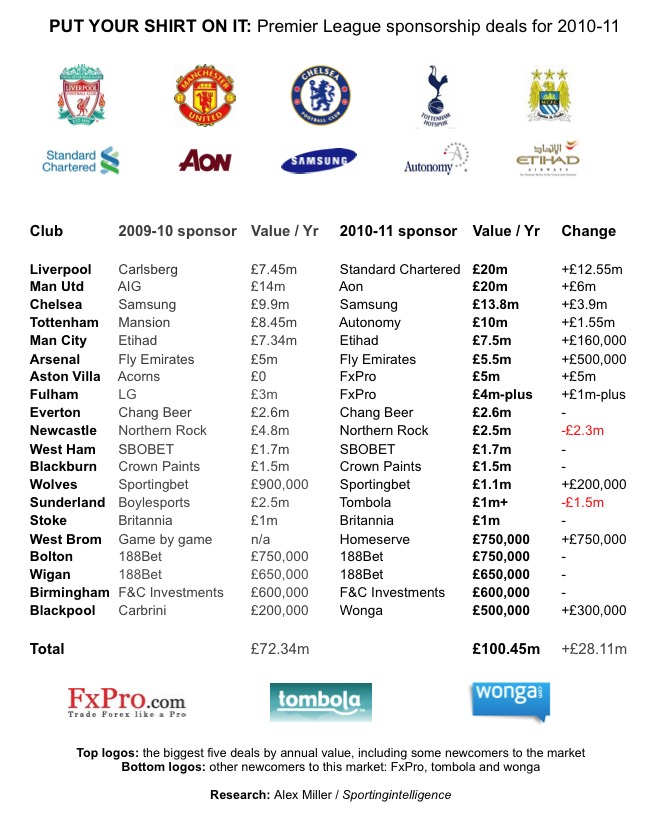
There's a funny bunch of shirt sponsors in the Premier League this year - with FxPro (you too can be a foreign exchange dealer) and 188BET (online gambling) hedging things by having two teams each - Fulham and Villa, and Bolton and Wigan, respectively.
The big money, however goes to four clubs, according to figures from Sporting Intelligence. Topping this year's list are Standard Chartered Bank, giving £20m to Liverpool this year, from operating profits of $5.15 billion in 2009. Alongside are AON, Chicago-based re-insurance specialists, giving Manchester United £20m from much slimmer profits of $747m. Then comes Samsung, whose price to Chelsea p.a is around £13.8m - easily spared from operating profits in electronics alone estimated at 11 trillion won in 2009 (even at 2,000 won to the pound)
The puzzle is British software company, Autonomy, who've signed up with Spurs for £10m this year, out of operating profits of $329m (around £210m) in 2009. An odd marketing ploy for a company who really sells B2B, against rivals such as IBM and Oracle. One presumes CEO Dr Michael Lynch, born in Ireland, but brought up in Essex, is a fan.
The big money, however goes to four clubs, according to figures from Sporting Intelligence. Topping this year's list are Standard Chartered Bank, giving £20m to Liverpool this year, from operating profits of $5.15 billion in 2009. Alongside are AON, Chicago-based re-insurance specialists, giving Manchester United £20m from much slimmer profits of $747m. Then comes Samsung, whose price to Chelsea p.a is around £13.8m - easily spared from operating profits in electronics alone estimated at 11 trillion won in 2009 (even at 2,000 won to the pound)
The puzzle is British software company, Autonomy, who've signed up with Spurs for £10m this year, out of operating profits of $329m (around £210m) in 2009. An odd marketing ploy for a company who really sells B2B, against rivals such as IBM and Oracle. One presumes CEO Dr Michael Lynch, born in Ireland, but brought up in Essex, is a fan.
Fest up
The Journal in Newcastle is reporting that 5Live's "Annual Septemberfest" will be coming live from Tyneside ahead of the Great North Run this year.
Last year, the event, the first, was called the "Annual Octoberfest". I'm sure we'll be getting details of this year's follow-up soon. Unless, of course, the event is just a week of outside broadcasts.
Last year, the event, the first, was called the "Annual Octoberfest". I'm sure we'll be getting details of this year's follow-up soon. Unless, of course, the event is just a week of outside broadcasts.
Sunday, August 15, 2010
Thursday, August 12, 2010
Plan B
September 1st is just over 2 weeks away. By then, BBC DG Mark Thompson hopes to have a revised scheme to address the BBC Pension Fund fund deficit. The unions think the date is designed to influence their strike ballot, which closes the next day. But Mr Thompson actually needs the new sums to feed to the BBC Pension Fund accountants, who are well on their way to an obligatory three-year evaluation of the deficit.
It's a yo-yo that shows, even with the most astute of investment managers, you can't really buck the market trend. In 2007, the fund showed a surplus of £275m. That swung to a deficit of £470m in 2008, and then an estimated deficit of c£2bn in 2009. The current £1.5bn gap is an estimate made for the BBC Executive, not by the Pension Fund.
The Trustees of the Pension Fund believe actions like the proposed 1% p.a. growth limit on pensionable salaries is a matter for the BBC Executive - though they have asked for a second opinion. And they have agreed that Trustees Zarin Patel and Caroline Thomson will step aside from discussions of this matter, as their principal obligations are as Director of Finance and COO on the Executive side.
The problems for Mark Thompson are real. Putting more of the licence-fee into the pension pot will raise the interest of the coalition and Treasury. Putting some executive perks back into the pot makes only psychological impact (and it's not clear all executives are behind the DG, in this fin de siecle period). Putting any profits from future property sales into the fund is also indirectly using the licence fee that acquired them - and there's no sign of big money coming in for Television Centre anyway.
Zarin and HR boss Lucy Adams were pretty adamant that the 1% cap was the only solution. Now the boss says they've got to find another one that works.
It's a yo-yo that shows, even with the most astute of investment managers, you can't really buck the market trend. In 2007, the fund showed a surplus of £275m. That swung to a deficit of £470m in 2008, and then an estimated deficit of c£2bn in 2009. The current £1.5bn gap is an estimate made for the BBC Executive, not by the Pension Fund.
The Trustees of the Pension Fund believe actions like the proposed 1% p.a. growth limit on pensionable salaries is a matter for the BBC Executive - though they have asked for a second opinion. And they have agreed that Trustees Zarin Patel and Caroline Thomson will step aside from discussions of this matter, as their principal obligations are as Director of Finance and COO on the Executive side.
The problems for Mark Thompson are real. Putting more of the licence-fee into the pension pot will raise the interest of the coalition and Treasury. Putting some executive perks back into the pot makes only psychological impact (and it's not clear all executives are behind the DG, in this fin de siecle period). Putting any profits from future property sales into the fund is also indirectly using the licence fee that acquired them - and there's no sign of big money coming in for Television Centre anyway.
Zarin and HR boss Lucy Adams were pretty adamant that the 1% cap was the only solution. Now the boss says they've got to find another one that works.
Tuesday, August 10, 2010
Downpipes

My favourite extant quango, CABE, remains unconvinced by the detailed design of the mangled metal tower proposed by Anish Kapoor for the Olympics site in Stratford. It says planning permission should not be granted until some basics are sorted. The (so far undrawn) buildings at the bottom need to include machinery to drive the lifts (and presumably sell tickets to queuing hordes); the pipe work needs to sort out how the wc's on the upper platforms will part with their waste; and CABE don't like the way the glass and mirrors round the viewing platforms are detailed.
I'm still waiting for the BBC to announce they're wedging in their infamous "portable" glass studio somewhere near the top.
Monday, August 9, 2010
Lap dogs
The latest FoI answer from the BBC, on lost or stolen laptops, mobiles etc, is instructive on the price Auntie pays for technology. 146 laptops have disappeared since April 2008, at a cost of £219k. That produces, very neatly an average cost of £1,500 per machine.
You and I could buy much more cheaply, of course, but the BBC supply contract is with Siemens, not PC World, and includes support for the machine and software, plus very scary firewalls and abstruse log-in procedures. However, when most staff issued with laptops only use them for emails and surfing, rather than video editing or audio production, there ought to be a much lower average.
You and I could buy much more cheaply, of course, but the BBC supply contract is with Siemens, not PC World, and includes support for the machine and software, plus very scary firewalls and abstruse log-in procedures. However, when most staff issued with laptops only use them for emails and surfing, rather than video editing or audio production, there ought to be a much lower average.
Saturday, August 7, 2010
Speakers
A farewell booking from Radio 4 Controller Mark Damazer - Antony Gormley will give the Reith Lectures in 2011. A bet from this blog - Gwyneth Williams' first pick will be a British woman.
Mr Damazer's track is male, with a slight American bias. Daniel Barenboim (2006, Argentina); Jeffrey Sachs (2007, USA), Jonathan Spence (2008, UK), Michael Sandel (2009, USA), Martin Rees (2010,UK). Mr Gormley will deliver one of his talks in New York.
Mr Damazer's track is male, with a slight American bias. Daniel Barenboim (2006, Argentina); Jeffrey Sachs (2007, USA), Jonathan Spence (2008, UK), Michael Sandel (2009, USA), Martin Rees (2010,UK). Mr Gormley will deliver one of his talks in New York.
Friday, August 6, 2010
Out of their Proms
Union strategists at the BBC are playing hardball over planned changes to the corporation's pension scheme. BECTU are talking about a 48-hour strike on September 10 and 11. Saturday 11th September is the last night of the Proms.
A co-ordinated 48-hour strike with the NUJ, and perhaps walkouts from Equity and the Musicians' Union would lead to two days of old movies and repeats. Management vaguely capable of pushing buttons to keep the transmitters fed would be stretched much more than previously.
There is a negotiation to be had, and some union officials have detailed proposals which would mean both staff and employer contributing more to the scheme, to ease the stark and frightening cap of 1% per year for rises to final pension figures.
A co-ordinated 48-hour strike with the NUJ, and perhaps walkouts from Equity and the Musicians' Union would lead to two days of old movies and repeats. Management vaguely capable of pushing buttons to keep the transmitters fed would be stretched much more than previously.
There is a negotiation to be had, and some union officials have detailed proposals which would mean both staff and employer contributing more to the scheme, to ease the stark and frightening cap of 1% per year for rises to final pension figures.
Thursday, August 5, 2010
It figures...
Football and politics served BBC radio well in the latest RAJAR listening figures. A record for Five Live (though not the digital Five Live Sports Extra), a record for Radio 4 - through Today to The Archers. A new high for 6Music, and a 22% year-on-year increase for the doomed Asian Network. BBC local radio lost 847,000 listener hours - about the same total lost by Radio 2. Dips for 1Xtra, BBC radio 7 and Radio 3 meant overall a lower share of a growing cake for the BBC, allowing commercial rivals to have a good quarter.
BBC, BBC, BBC
 The BBC is asking for planning permission to put three logos on three buildings at MediaCityUK (spotted by the ever-reliable CDX on the excellent thread at Skyscraper City).
More interesting will be a decision on what to call the buildings, currently affectionately known as A, B and C. And a way for the public to find which one they should go to....
Wednesday, August 4, 2010
Trust Birtists
The suggestion that Ian Hargreaves is a contender for BBC Trustee for Wales is interesting. It usually goes to a Welsh speaker, and despite some years working in Cardiff, I don't think Mr Hargreaves has got that far..
If, however, his candidature is successful, the Trust will take on an increasingly Birt-ist look. Ian and David Liddiment were both appointed to the BBC by John Birt; Richard Ayre toiled under the inky-blue note cards issued by Birt to News; and the good Lord described Patricia Hodgson as a "soulmate".
If, however, his candidature is successful, the Trust will take on an increasingly Birt-ist look. Ian and David Liddiment were both appointed to the BBC by John Birt; Richard Ayre toiled under the inky-blue note cards issued by Birt to News; and the good Lord described Patricia Hodgson as a "soulmate".
Salary spread
I know I shouldn't be encouraging BBC executives to seek higher salaries, but it's interesting to note this recent FoI release, designed to discover staff members earning more than the Prime Minister, on a basic of £142,500.
117 posts make the list - we've known about 72 through previous BBC disclosures. The remainder are only indicated by their job titles, in bands of 30k. What's interesting to me is that Audio & Music supply no posts in the additional list. Beyond Tim Davie, the Controllers, Head of Production Graham Ellis and Head of Interactive Mark Friend, no-one is on more than £130k. There are 19 such posts in Vision, 6 in Future Media and Technology, 4 in Finance, and 2 in Journalism. It would never have happened in Jenny Abramsky's day....
117 posts make the list - we've known about 72 through previous BBC disclosures. The remainder are only indicated by their job titles, in bands of 30k. What's interesting to me is that Audio & Music supply no posts in the additional list. Beyond Tim Davie, the Controllers, Head of Production Graham Ellis and Head of Interactive Mark Friend, no-one is on more than £130k. There are 19 such posts in Vision, 6 in Future Media and Technology, 4 in Finance, and 2 in Journalism. It would never have happened in Jenny Abramsky's day....
Tuesday, August 3, 2010
Dosh dished
The impending demise of the NWDA has produced one interesting item - a list of the projects they were considering part-funding, and now can't. It's extraordinary what the word "development" allowed the agency to contemplate. A full list can been found at Place North West.
English Half Marathon
Trafford Park Masterplan (surely that's a developer's job ?)
National Football Museum, URBIS
Regional Aero Park - Samlesbury - Phase II
St Annes public realm - Open Golf 2012
Manchester Ship Canal Aeration, Salford Quays (does lack of funding mean it'll pong near MediaCityUK ?)
Liverpool Metropolitan Cathedral Arts Project
Trinity Mirror Transformation Project (I thought they were making money now...)
There's something of a medieval court here, considering petitions from the poor burghers, and graciously handing out groats. Probably time it was done differently.
English Half Marathon
Trafford Park Masterplan (surely that's a developer's job ?)
National Football Museum, URBIS
Regional Aero Park - Samlesbury - Phase II
St Annes public realm - Open Golf 2012
Manchester Ship Canal Aeration, Salford Quays (does lack of funding mean it'll pong near MediaCityUK ?)
Liverpool Metropolitan Cathedral Arts Project
Trinity Mirror Transformation Project (I thought they were making money now...)
There's something of a medieval court here, considering petitions from the poor burghers, and graciously handing out groats. Probably time it was done differently.
Monday, August 2, 2010
Service resumed
We now know two out of three things unresolved as I took a short break. Gwyneth Williams is the new Controller of Radio 4 and 7/4 extra. BBC Breakfast is moving to Salford. Fabregas is still with Arsenal - and my guess is that he will stay for one more year.
The move of BBC Breakfast to Salford is a test for the corporation's personnel team on a number of fronts. In previous times in BBC News, the bulk of staff producing the programme rotated through various departments in the division, to limit their time doing nights on a show that didn't get watched by their bosses (who still tune to Today). Now, apparently, Breakfast staff can be specifically identified, and "offered" the move north. Their alternatives are to find their own internal BBC escape route, or risk redundancy - and they have less time to do it than all those fingered first.
The context is not good. Peter Salmon, Director of the North, is not moving, but will rent a flat for weeknights. The "revelation" that Adrian Van Klaveren, Controller of Radio 5 Live is doing the same is old news; producers on his network have known that for some time. Hayley Valentine, brought in to run 5 Live News Programmes on the understanding that she would make the move, has now found family commitments too much, and the hunt is on for a replacement. Peter Salmon's number 2, Richard Deverell, who lives in Guildford, has yet to announce his plans. Barbara Slater, Controller of Sport, lives in west London, and has so far only committed to a "full working week in Manchester" - so that's alright.
Many staff at lower grades facing the move to Salford don't have the income to leave a partner in London looking after children to ensure continuity of education; many of the staff facing the move to Salford don't have an option of alternative employment. And who will Salford-based producers turn to in that revered BBC process of "referring upwards" when a weekend editorial decision becomes tricky ? It currently looks like London every time.
The move of BBC Breakfast to Salford is a test for the corporation's personnel team on a number of fronts. In previous times in BBC News, the bulk of staff producing the programme rotated through various departments in the division, to limit their time doing nights on a show that didn't get watched by their bosses (who still tune to Today). Now, apparently, Breakfast staff can be specifically identified, and "offered" the move north. Their alternatives are to find their own internal BBC escape route, or risk redundancy - and they have less time to do it than all those fingered first.
The context is not good. Peter Salmon, Director of the North, is not moving, but will rent a flat for weeknights. The "revelation" that Adrian Van Klaveren, Controller of Radio 5 Live is doing the same is old news; producers on his network have known that for some time. Hayley Valentine, brought in to run 5 Live News Programmes on the understanding that she would make the move, has now found family commitments too much, and the hunt is on for a replacement. Peter Salmon's number 2, Richard Deverell, who lives in Guildford, has yet to announce his plans. Barbara Slater, Controller of Sport, lives in west London, and has so far only committed to a "full working week in Manchester" - so that's alright.
Many staff at lower grades facing the move to Salford don't have the income to leave a partner in London looking after children to ensure continuity of education; many of the staff facing the move to Salford don't have an option of alternative employment. And who will Salford-based producers turn to in that revered BBC process of "referring upwards" when a weekend editorial decision becomes tricky ? It currently looks like London every time.
Subscribe to:
Comments (Atom)